HSA for Parents: How to Maximize Your Health Savings Account in 2026
Executive Summary
You can access an HSA only if you are enrolled in a High Deductible Healthcare Plan (HDHP), which the IRS defines based on its minimum annual deductible and maximum out-of-pocket expenses.
In 2026, the maximum HSA contribution is $4,400 if covered under a Self-Only (Individual) HDHP and $8,750 if covered under a Family HDHP. These contributions assume you were covered for the full year.
Your maximum contribution can be limited if you switch healthcare plans during the year. This is common for parents, especially for parents who welcomed their first child during the year.
If HSAs are used properly, they offer a triple tax advantage that no other investment account can offer.
For many parents, an HSA is beneficial and something to consider as part of your financial plan.
Should I have an HSA as a parent?
Having worked with numerous parents of all ages, I can definitively say that using an HSA was a benefit for the vast majority of these parents.
When it comes to managing healthcare costs for you and your family, a Health Savings Account (HSA) can be a powerful tool. Whether you’re planning for future medical expenses or looking for a tax-efficient savings vehicle, understanding how an HSA works can help you make smarter financial decisions.
How does a Health Savings Account work?
Do you have an HDHP? (Eligibility Basics)
You may set up an HSA only if you are covered by a qualifying High-Deductible Healthcare Plan (HDHP).
| Individual HDHP Coverage | Family HDHP Coverage | |
|---|---|---|
| Minimum Annual Deductible | $1,700 | $3,400 |
| Maximum Annual Deductible and Out-of-Pocket Expenses* | $8,500 | $17,000 |
As the name implies, an HDHP has a higher annual deductible than typical health plans. The IRS has strict guidelines on what constitutes an HDHP. These guidelines are based on whether you have a self-only (individual) healthcare plan or a family healthcare plan.
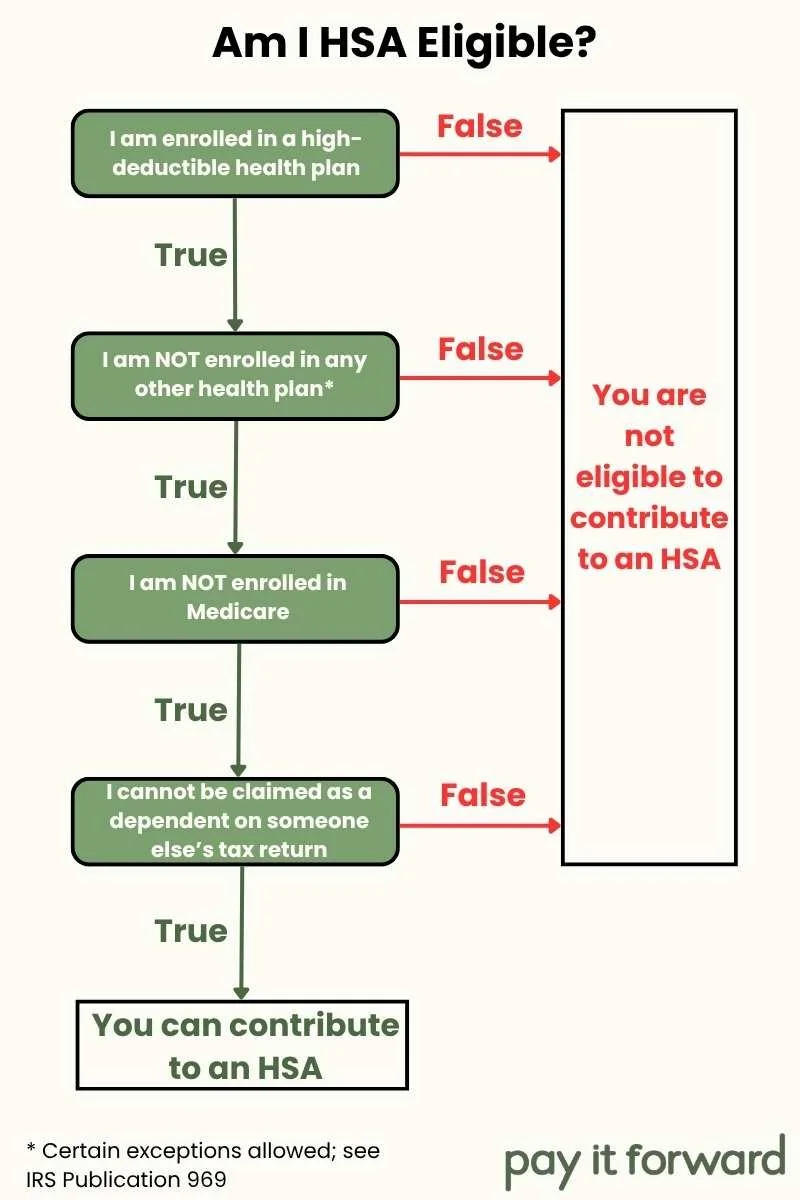
Flowchart of HSA Eligibility Requirements
In addition to having an HDHP, there are a few more requirements you must meet to contribute to an HSA:
You have no other health coverage. This is extremely relevant if you’re married. You need to make sure that you’re not covered under your spouse’s health insurance plan.
You aren’t enrolled in Medicare (age 65).
You can’t be claimed as a dependent on someone else’s tax return. The most common scenario is if you could be claimed as a dependent on your parent(s) tax return.
Contributing to Your HSA
You can contribute to your HSA through payroll deductions or directly from your bank account.
For most parents, their HSA is an employer-provided benefit. If this is you, you should be able to set up payroll-deducted contributions, just like your 401(k)/403(b) contributions. Also, your employer can make contributions into your account, although any employer contributions must reduce the amount you can contribute.
You can also make lump-sum contributions via direct withdrawal from your bank account.
Regardless of how you make your HSA contributions, they need to be reported on Form 8889
Investing vs. Holding Cash in Your HSA
Your HSA provider will likely force you to keep a certain amount in cash, but the remaining funds can be invested.
As an example, my wife’s HSA requires a minimum cash balance of $2,000. However, she can invest any money above that $2,000 cash balance.
How much you decide to keep in cash versus investing for future needs is specific to you and your family’s financial and medical situation. Nonetheless, here are some reasons why you may want to consider holding more cash:
You, or a spouse/child, have large expected medical bills.
You or your spouse are approaching retirement. Typically, older individuals have larger medical expenses than younger individuals. Thus, it’s more likely you will take an HSA withdrawal
You are risk averse. For individuals who don’t like to see large fluctuations in their account, then holding more cash will make your account fluctuate less than if you were to invest those funds in stock investments.
For many, how much cash you should hold in your HSA largely depends on how soon you envision needing to take a withdrawal and the amount of projected withdrawals. The greater the likelihood, and/or the larger the projected withdrawals, the more you may want to consider holding a larger cash balance.
Thinking of my current clients, I’d say the typical parent in their 30s is holding a cash balance of $4,000 - $6,000 in their HSA. This is specific to them and should not be construed as financial advice.
Spending Your HSA Funds
Withdrawals can be made through an HSA debit card or reimbursed after paying the qualified medical expense.
In general, your withdrawal should be used for a “qualified medical expense”, which is for the benefit of you, your spouse, or any dependent you claim, or could claim, on your tax return.
Assuming your withdrawal was for a qualified medical expense, then you will report the distribution on Form 8889. Even though you are required to report the withdrawal, they are tax-free.
Lastly, recordkeeping is a big deal! You must keep sufficient records to show that the withdrawals were exclusively for qualified medical expenses, hadn’t been previously paid or reimbursed, and hadn’t been taken as an itemized deduction on your tax return. My recommendation is for you to keep any receipt or bill associated with an HSA withdrawal.
Are There Rules for Health Savings Accounts?
Who Can I Use My HSA On?
There are differences between eligible dependents for HSA purposes versus dependents on your tax return.
If you’re married, you can reimburse yourself for the qualified medical expenses of your spouse, regardless of whether they are covered under your HDHP or not.
Any dependent claimed on your tax return is eligible to have their qualified expenses reimbursed with your HSA.
As you’ll read below, you can even reimburse certain dependents that are not claimed on your tax return, provided they meet various IRS exceptions.
Using an HSA as a Divorced Parent or Co-Parenting Families
The custodial parent doesn’t matter when determining qualifying withdrawals from an HSA.
Per IRS Publication 969, “a child of parents that are divorced, separated, or living apart for the last 6 months of the calendar year is treated as the dependent of both parents whether or not the custodial parent releases the claim to the child’s exemption.”
As an example, if your divorce decree requires you to pay 65% of your child’s medical expenses, you can use your HSA to cover your portion of your child’s medical costs. Your ex-spouse can use their respective HSA to cover their portion of your child’s medical expenses. Again, this is independent of who actually claims the child as a dependent on their tax return.
What Happens If I Change Health Plans Mid-Year?
You must either calculate the appropriate prorated contribution or use the “last month rule.”
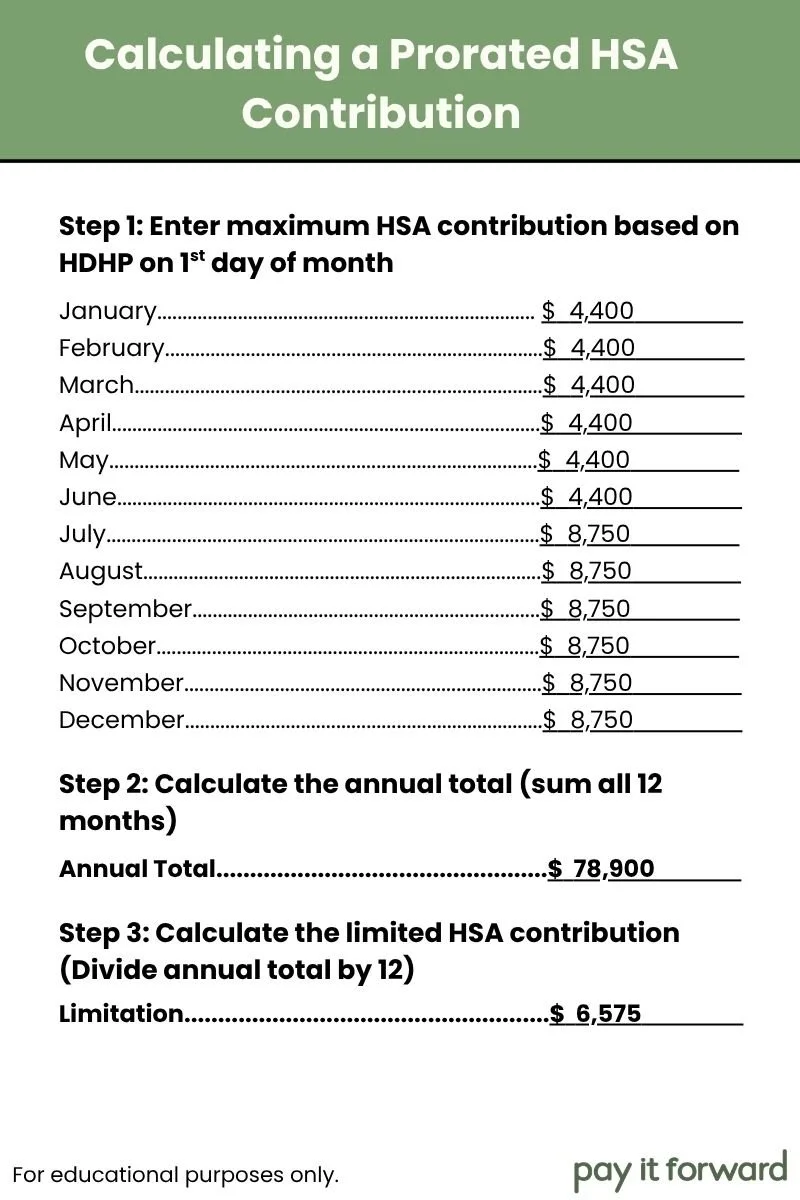
Prorated HSA contribution when HDHP changes July 1st
If you switch from an HDHP to a non-HDHP, or vice versa, part-way through the year, or go from an Individual HDHP to a Family HDHP during the year, then you have two options to choose from when determining your maximum allowable contribution. The IRS allows you to contribute the larger of the two options.
First, you can calculate a prorated contribution using the Limitation Chart and Worksheet via Instructions for Form 8889.
Example: Sarah, 34, and Connor, 33, are married, but are covered under separate healthcare plans. Sarah is covered under a non-HDHP while Connor is covered under an HDHP. Sarah gives birth to the couple’s first child on June 14, 2026. The couple decides that they’ll all be covered under a Family HDHP through Connor’s employer moving forward. Coverage begins July 1, 2026. How much can Connor contribute to his HSA in 2026?
Using the Limitation Chart and Worksheet, you’ll see that Connor enters the maximum contribution of $4,400 for the months he’s covered under an Individual HDHP, but enters $8,750 for the months he’ll be covered under a Family HDHP. From there, he will sum the maximum allowable contribution for each of the 12 months. The last step is to divide by 12. The resulting contribution of $6,575 represents the limited (prorated) maximum contribution.
The second option available to you if you switch healthcare plans during the year is known as the last-month rule.
Under the last-month rule, if you are covered under an HDHP and meet all other eligibility rules, on the last month of your tax year (for most that’s December 1st), you are treated as though you were HSA-eligible for the entire year.
Looking back at the example above with Sarah and Connor, the last-month rule allows Connor to make the maximum HSA contribution of $8,750 in 2026, an increase of nearly $2,200 over the prorated amount.
So what’s the catch? For most taxpayers, that means you must remain an eligible individual and covered by an HDHP through December 31st of the following year. If not, you’ve over-contributed to your HSA and will be required to take out the excess contributions and correct your mistake.
Can I Use my HSA After I Turn 65 Years Old?
Absolutely! You can take withdrawals from your HSA at any age.
There’s no age restriction on when you can access your HSA funds without incurring a penalty, or including the withdrawal as taxable income, unlike retirement plan accounts like 401(k) plans or IRAs.
A common mistake people make is continuing to contribute, or trying to contribute, to their HSA after they enroll in Medicare, which for a majority of people is when they turn age 65.
Are There Limits on Health Savings Accounts?
Contribution Limits for 2026
$4,400 for self-only HDHP and $8,750 for family HDHP
These contribution limits include the combined total of any contributions you make via payroll deduction or lump-sum AND any employer contributions into your HSA. If your employer makes contributions into your HSA, then you need to subtract those from your maximum allowable contribution.
Again, the contribution limits ARE NOT just how much you contribute into your HSA. They include whatever contribution your employer makes, too.
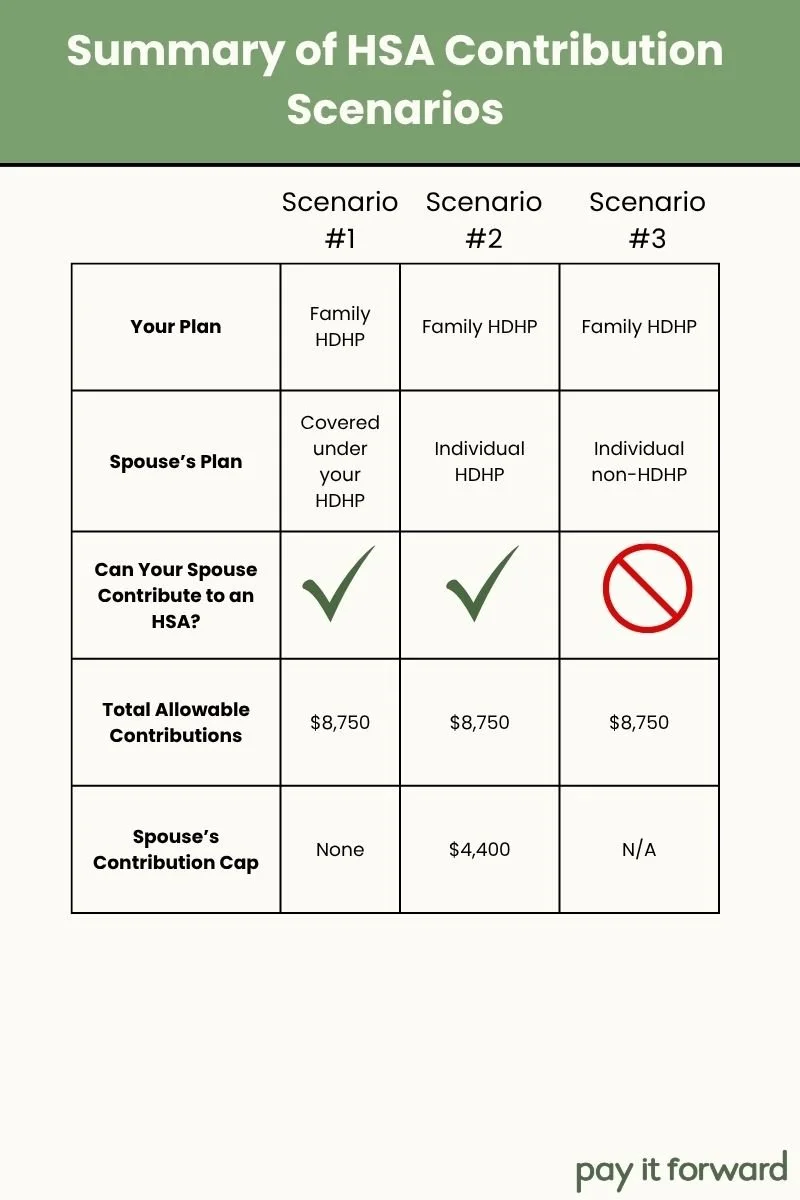
HSA Contributions can vary depending on your family’s healthcare coverage.
While the contribution limits appear straightforward, for many parents, especially married couples, figuring out your contribution limit can be confusing.
Scenario #1: You, Your Spouse & Child(ren) are all covered under your Family HDHP
You’re employed, and your employer is providing the health insurance for your family. In this scenario, you & your spouse can EACH have your own HSA. However, you and your spouse share the family maximum contribution of $8,750, which means the combined contributions cannot exceed $8,750.
You and your spouse can agree to split the $8,750 maximum between your separate HSAs however you’d like. It doesn’t have to be a 50/50 split. Furthermore, you can decide to contribute the entire $8,750 into one HSA and forego your spouse contributing to their own HSA.
Scenario #2: You and your child(ren) are covered under a Family HDHP. Your spouse is covered under their own Individual HDHP.
This is a common situation that I see with parents who both work and have access to HDHPs. Both you and your spouse are eligible to contribute to an HSA, BUT you are treated as having one family plan. Therefore, your combined contributions across all HSAs cannot exceed the family maximum ($8,750).
In addition to the family maximum, your spouse cannot contribute more than the individual contribution limit of $4,400 into their HSA.
Scenario #3: You and your child(ren) are covered under a Family HDHP. Your spouse is covered under their own Individual non-HDHP.
Again, a very common situation for dual-income parents, and similar to Scenario #2. This time, your spouse is not eligible to contribute to an HSA. Recall the eligibility rules from earlier (anchor link), which require you to be covered under an HDHP before contributing to an HSA. Still, you are entitled to contribute up to the family maximum into your HSA.
Ultimately, your spouse’s ability to contribute to their own HSA is the only difference between this scenario and the previous scenario.
These are just a few of many different variations that you could encounter throughout your working career. I highly recommend that you work with a tax professional if you are unsure of how much you, and your spouse, can contribute to your respective HSAs.
Can I Contribute More to My HSA If I’m Age 55 or Older?
Yes! There’s a $1,000 catch-up contribution if you’re 55 or older.
If you’re enrolled in an HDHP for the entire calendar year, you’re eligible to contribute the full $1,000 catch-up contribution regardless of when you turned 55. There is no prorating, which saves you a lot of time and calculations!
The catch-up contribution comes with a caveat, though. You can only make a catch-up contribution into an HSA where you are the account owner. If you don’t have your own HSA, then you can’t make any contribution, let alone a catch-up contribution.
To reiterate, the catch-up contribution applies to each qualifying individual. So, if you and your spouse each have an HSA, and you’re both 55 or older, then you both can make a full $1,000 catch-up contribution into your respective HSA.
What are the Contribution Deadlines for HSAs?
You have until April 15, 2027 to contribute for the 2026 tax year.
Similar to IRAs, the IRS allows taxpayers until April 15th (tax filing day) to contribute for that specific tax year. Typically, any contribution you make between January 1st and April 15th must come from your bank account.
One of the biggest mistakes people make is selecting the wrong tax year for a lump-sum contribution.
When you log in to your HSA provider and navigate to the contribution screen, you’ll get asked: ‘Which tax year should receive this contribution?’ You must select the appropriate tax year.
Example: John is 31 years old, and covered under an Individual HDHP for all of 2026. He contributed $100 per paycheck ($2,600 total) to his HSA. John is sitting down to complete his tax return on March 1, 2027, and realizes that he still has time to make the maximum HSA contribution for 2026.
John logs in to his HSA provider’s website and completes an $1,800 contribution. He selects tax year 2026 to ensure the tax deduction is correctly taken on his 2026 tax return.
What Are the Tax Benefits of a Health Savings Account?
The Triple Tax Advantage, Explained
If used properly, HSA money is never taxed.
You may have heard this before, but tax benefits are one of the main reasons financial professionals advocate using an HSA. Specifically, an HSA is the only investment account with:
Tax-Deductible Contributions: The money you contribute reduces your taxable income for the year.
Tax-Deferred Growth: Any investment earnings within your HSA accrue without any annual tax payment, similar to retirement accounts and IRAs.
Tax-Free Withdrawals: When you use HSA funds for qualified medical expenses, withdrawals are completely tax-free.
So, your contributions aren’t included in your taxable income, the investment growth avoids annual taxation, and any qualifying withdrawal is exempt from taxation. Pretty sweet deal when used correctly!
How to Use an HSA as a ‘Stealth’ Retirement Account
There’s no 20% penalty for non-qualified withdrawals once you turn age 65.
If you’re under the age of 65, any withdrawal you make from your HSA must reimburse qualifying medical expenses. Otherwise, you’ll include those non-qualifying withdrawals as income AND pay a 20% penalty tax on the amount of non-qualifying withdrawals.
Once you turn 65 years old, that 20% penalty tax goes away. You’ll still include any non-qualifying withdrawal as income, but that’s no different than a pre-tax IRA or pre-tax 401(k).
By no means am I advocating for any person age 65 or older to take a withdrawal to pay for an airline ticket. However, if you are worried about “overfunding” an HSA, then you can rest assured that you could still take withdrawals to cover non-medical expenses, but those withdrawals lose their tax-free privilege.
How do HSAs Compare to my IRA or 401(k)?
HSAs can be triple tax-advantaged accounts, whereas IRAs and 401(k)s are not.
As I mentioned previously, an HSA allows taxpayers to deduct any contribution from income, and qualified withdrawals are tax-free. The growth along the way is tax-deferred, meaning any tax is delayed until you take a withdrawal.
Similar to HSAs, IRAs and 401(k) retirement plans provide taxpayers with tax-deductible contributions and tax-deferred growth. Unlike HSAs, though, withdrawals ARE NOT tax-free. Except in certain cases, every $1 you withdraw will be included in your taxable income and subject to taxation.
Beyond taxes, HSAs, IRAs, and 401(k) plans act pretty similarly. You have the option to invest within the accounts and name beneficiaries who will inherit your account upon your passing.
HSA for Parents by Age: 30s, 40s, and 50s
Parents in Their 30s: Getting Started and Building Habits
Your 30s are about making your first contribution and consistently adding more into your HSA.
Many parents in their 30s are healthy enough that the lower premium of an HDHP outweighs the potentially large out-of-pocket expenses. This stage of parenthood typically brings large medical bills (e.g., labor and delivery expenses), but the expenses tend to be more predictable.
In general, parents in their 30s will hold more cash in their HSAs than they will later in parenthood because upcoming expenses are more near-term. Also, their HSAs are lower in value, so a larger percentage of the account needs to be held as cash.
My recommendation is to get started with an HSA if you’re currently enrolled in an HDHP. Even a modest payroll contribution can save you plenty in taxes and provide peace of mind that large medical expenses in the future won’t sink your finances.
Parents in Their 40s: Shifting From Spending to Investing
Years of diligent savings are paying off. Your HSA is going to work for you, not just reimbursing you.
This is around the time that I see a parent’s HSA start to take off.
For many, their compensation has increased, allowing them to potentially “max out” their contributions. In addition, parents in their 40s can typically absorb more medical costs through their monthly budget. In doing so, they don’t have to replenish the cash in their HSA. Ultimately, more of their contributions can be invested for long-term growth.
My recommendation for parents in their 40s is to generally try to “max out” contributions. At some point, they may no longer want to be on an HDHP as they get older, making them ineligible to contribute to an HSA.
Parents in Their 50s: Playing “Catch-Up” and Planning an Exit
Your mid-50s are about catch-up contributions and looking at how you’ll take withdrawals.
Some parents will no longer be enrolled in an HDHP at this point. For those that are, though, it’s a good time to make the $1,000 catch-up contribution so long as you qualify. This is especially true since you cannot make contributions once you enroll in Medicare at age 65.
This is also a good time to begin drafting a game plan on how you’ll take withdrawals from your HSA. You can reimburse yourself, or your spouse, for Medicare Part B premiums. Also, recall the “stealth” retirement strategy, where non-qualified withdrawals after age 65 no longer carry a 20% penalty.
My recommendation is to not worry about “overfunding” your HSA. These funds can either cover large, unexpected medical bills, or can be treated like other retirement accounts once you turn 65.
Frequently Asked Questions
Should I use my HSA for every medical expense?
In general, it’s better to let the money inside your HSA grow.
For most of my clients, I try to deter them from using their HSA for nominal expenses, like copays and over-the-counter medications. If money is tight, and the medical expense would cause you to carry credit card debt, then you should absolutely consider using your HSA. However, the power of the HSA is its ability to grow over time. So, if you can afford to pay expenses out of pocket, then that is generally the better option to pursue.
Can I use my HSA to pay for my insurance premiums?
No, you cannot take HSA withdrawals to reimburse yourself for your payroll-deducted medical plan premiums.
However, there are certain exceptions, like the ability to take HSA withdrawals to cover health care coverage while receiving unemployment compensation, or to pay for Medicare premiums once you turn 65 years old.
Can married couples have a joint HSA?
No! HSAs are individually-owned accounts.
You can name your spouse as beneficiary of your HSA, but they cannot be a joint owner of the account.
What if I contribute too much to my HSA?
Excess contributions aren’t deductible and could incur a 6% penalty tax.
Fixing an overcontribution requires you to make a corrective withdrawal. If done promptly, the overcontribution can avoid the 6% penalty tax. The two key requirements are:
Excess contributions are withdrawn by the due date of your tax return, including extensions. For most people, that’s April 15th (October 15th if extending).
You withdraw any income earned on the withdrawn contributions and include the earnings as “Other Income” on your tax return.
What happens if I die with money still in my HSA?
Your beneficiaries inherit their respective portion of your HSA.
If your spouse inherits your HSA, it will be treated as your spouse’s HSA after your death.
If a non-spouse (likely your child(ren)) inherits your HSA, it stops acting like an HSA. Furthermore, the non-spouse must include the inherited portion as taxable income. The taxable income is reported on the tax return corresponding to the year you pass.
Are HSAs or FSAs Better?
Most parents will benefit from using an HSA over an FSA.
The biggest drawback of an FSA is that it is a “use-it-or-lose-it” type of account. If your plan allows, the maximum carryover amount is $680. The risk you face is that you overfund your FSA, only to have the unused funds returned to your employer. With an HSA, you can contribute year after year and let the account accumulate over time. There’s no “use-it-or-lose-it” rule.
Another drawback of an FSA is the lower contribution limits. For 2026, the maximum allowable contribution is $3,400 per individual. For those covered under an Individual HDHP, you could contribute $4,400 to your HSA.
While FSAs have their drawbacks, they do provide you with the ability to reimburse yourself for medical expenses when you are not covered under an HDHP. That’s one big advantage of an FSA over an HSA. There’s no stipulation that you must be enrolled in a specific type of medical plan.
Should I have an HSA as a Parent?
Assuming an HDHP is appropriate, then I often say yes!
The biggest caveat as to whether you should have an HSA is whether enrolling yourself, or your family, in an HDHP is appropriate.
If an HDHP makes sense when compared to other options, then I generally recommend parents get started with an HSA.
Medical expenses are one of the largest outflows for retirees. Medical costs aren’t coming down, so the earlier you can set aside money to cover these expenses, the better. There’s no better account in existence to help you pay for medical costs.
Next Steps
Deciding to enroll in an HDHP and fund an HSA depends on your unique health needs and financial goals. A financial planner can help you evaluate your options and design a strategy tailored to you.
If you’d like to discuss how an HSA can fit into your financial plan, feel free to reach out to me at matthew@payitforwardfp.com. I’m happy to help you navigate these decisions and maximize your savings.